
Casino Algorithms: Unveiling the Secrets of Random Number Generators (RNGs)

Have you ever wondered if the spin of the roulette wheel or the shuffle of the virtual deck is truly random? The perception of chance is the bedrock of the casino experience, but behind the flashing lights and enticing sounds lies a complex world of casino algorithms, specifically random number generators, or RNGs. Are these RNGs genuinely unpredictable, or are they sophisticatedly designed to subtly favor the house?
The debate surrounding the fairness of casino algorithms is not just theoretical; it has real-world implications for anyone who participates in online gambling. This article aims to explore the intricate world of casino RNGs, examining how they work, the measures in place to ensure fairness, and the ongoing discussion about whether true randomness can ever truly exist within the carefully constructed environment of a casino. By understanding the mechanics and the controversies, players can make more informed decisions and approach online gambling with a healthy dose of skepticism and awareness.
What are Random Number Generators (RNGs)?
Random Number Generators (RNGs) are the backbone of chance in the digital world, especially when it comes to casino games. In essence, an RNG is an algorithm, a set of instructions, designed to produce a sequence of numbers that appear statistically random. Think of it as a digital dice roll, card shuffle, or roulette wheel spin.
But why are RNGs so important? In a brick-and-mortar casino, physical mechanisms—cards, dice, wheels— inherently introduce randomness. Online, however, everything is code. Without RNGs, the outcome of every spin of an online slot machine, every deal in online blackjack, or every rotation of a digital roulette wheel would be predictable, and that’s the antithesis of gambling.
Consider online slots. Each spin relies on the RNG to determine which symbols land on the reels. In blackjack, the RNG shuffles the virtual deck after each hand, ensuring a fair and unpredictable distribution of cards. Even in roulette, the RNG dictates where the ball will land on the virtual wheel. Without these algorithms, online casino games would be easily exploitable.
The use of RNGs aims to replicate the uncertainty and excitement of traditional casino games, and more importantly, they are crucial for ensuring fairness. Reputable online casinos employ sophisticated RNGs that are regularly tested and certified by independent auditing firms, providing players with confidence that the games are not rigged and the outcomes are genuinely random.
Types of RNGs: True vs. Pseudo
Random Number Generators (RNGs) are not all created equal. They broadly fall into two categories: True Random Number Generators (TRNGs) and Pseudo-Random Number Generators (PRNGs). The core difference lies in how they produce seemingly random numbers.
True Random Number Generators (TRNGs)
TRNGs harness unpredictable physical phenomena to generate random numbers. Think radioactive decay, atmospheric noise, or even the subtle variations in the timing of keystrokes. These physical processes are inherently random, meaning there’s no way to predict the next number they’ll produce. This method gives TRNGs a high level of security and ensures the outputs are unbiased, vital for fairness. However, TRNGs come with their own set of challenges. Implementing them can be complex and costly, requiring specialized hardware and careful calibration. Imagine building a system that accurately captures the randomness of background radiation – it is not an easy task!
Pseudo-Random Number Generators (PRNGs)
PRNGs take a different approach. Instead of relying on physical phenomena, they use deterministic algorithms – sets of rules – to generate sequences of numbers. These algorithms start with an initial value called a “seed.” Given the same seed, a PRNG will always produce the same sequence of numbers. This might sound like PRNGs aren’t random at all, and technically, that’s true. If you knew the algorithm and the seed, you could predict the entire sequence. However, modern PRNGs employ complex calculations that make it computationally infeasible to reverse-engineer the seed from the output, even with powerful computers Think of it as an extremely complicated math problem – technically solvable but practically impossible. One example is the Mersenne Twister, a widely used PRNG known for its long period and statistical properties. The key is that their output appears indistinguishable from true random numbers, at least to statistical tests.
Because of their lower cost and easier implementation, PRNGs are widely used in iGaming. They offer a practical way to provide random numbers that are ‘random enough’ for most applications, balancing the need for security and unpredictability with efficiency and affordability.
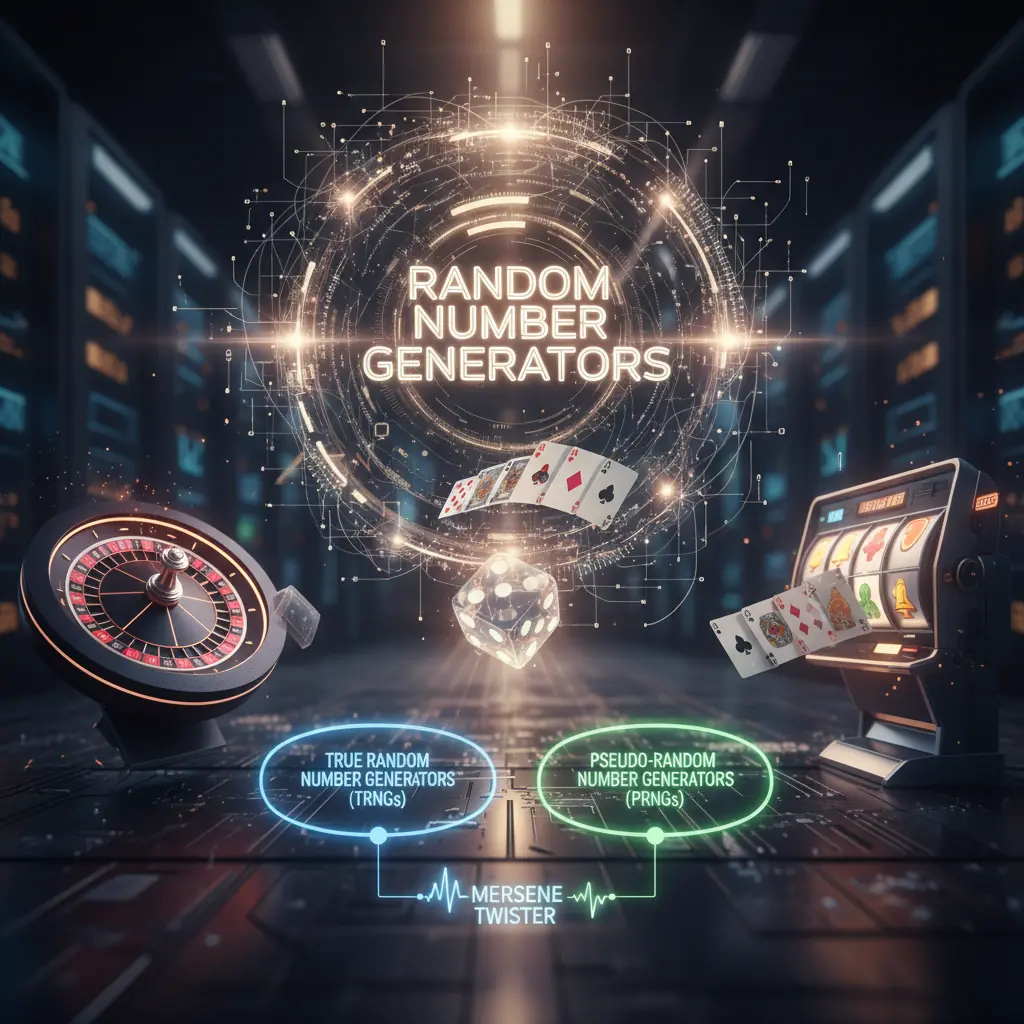
How PRNGs Work in Online Casinos
Online casinos rely on Pseudo-Random Number Generators (PRNGs) to ensure fairness and unpredictability in games. Unlike true random number generators that depend on unpredictable physical phenomena, PRNGs are algorithms designed to produce sequences of numbers that appear random but are entirely deterministic. Their operation hinges on a starting point called a “seed,” which dictates the entire subsequent number sequence. The seed value is absolutely crucial; if known, the entire sequence can be predicted.
The seeding process often involves several elements to make the initial value as unpredictable as realistically possible. Common seeding methods include using the system clock’s current time, gathering bits of seemingly random user input (like mouse movements or keystroke timings), and employing hardware-based random number generators, if available. Combining these elements generates a more complex and less predictable seed value.
Once the seed is established, a PRNG algorithm takes over. These algorithms are mathematical formulas crafted to transform the seed into a long string of seemingly unrelated numbers. A widely used algorithm is the Mersenne Twister, known for its speed and ability to generate exceptionally long sequences before repeating. However, even Mersenne Twister has its drawbacks; its output, while statistically random, can exhibit certain patterns if not carefully implemented.
To further enhance unpredictability, online casinos frequently incorporate cryptographic hash functions. These functions take the output of the core PRNG algorithm and scramble it, creating a more uniformly distributed and less predictable sequence. Cryptographic hash functions are designed to be one-way, meaning it’s computationally infeasible to reverse the process and derive the original input from the hashed output. This adds an extra layer of security, making it harder for malicious actors to predict the numbers generated by the PRNG.
In short, PRNGs in online casinos generate randomness through a carefully orchestrated process. A seed is created from various sources, fed into an algorithm like Mersenne Twister, and often further processed with cryptographic hash functions. While not truly random, the resulting sequences are designed to be statistically sound and unpredictable enough to provide a fair and engaging gaming experience.
Ensuring Fairness: Testing and Regulation
To ensure fairness and maintain the integrity of casino games, Random Number Generators (RNGs) undergo rigorous testing and are subject to strict regulatory oversight. This multi-layered approach aims to guarantee that the outcomes in games of chance are truly random, unbiased, and unpredictable.
Independent auditing of RNGs is paramount. Reputable testing agencies, such as Gaming Laboratories International (GLI) and eCOGRA, play a crucial role in this process. These organizations employ sophisticated testing methods to verify the randomness, distribution, and unpredictability of RNGs. Statistical analysis, frequency distribution tests, and entropy assessments are just some tools used to determine whether an RNG meets the required standards.
Gaming jurisdictions worldwide have established regulations for RNG certification. These regulations often include specific requirements for the testing process, documentation, and ongoing monitoring. Casinos must obtain gaming licenses and demonstrate compliance with these regulations to operate legally. Failure to meet these standards can result in hefty fines, license suspension, or even revocation.
The consequences for casinos unable to demonstrate the fairness and compliance of their RNGs are severe. By adhering to strict RNG testing and regulatory standards, the gaming industry aims to foster player confidence and maintain a level playing field for everyone.
Potential Biases and Vulnerabilities
Random Number Generators, while designed to introduce chance, are not immune to biases and vulnerabilities. These shortcomings can potentially compromise the fairness and integrity of games that rely on them.
One common issue is RNG bias, where the generator produces numbers that are not uniformly distributed. Instead of a truly random spread, certain numbers or sequences may appear more frequently than others. This can manifest as short cycles, where the same sequence of numbers repeats after a relatively small number of iterations. Another bias can be clustering, where generated numbers tend to group together instead of being evenly distributed across the possible range.
These vulnerabilities can be exploited. Knowledgeable players can potentially identify patterns or biases in an RNG’s output and use this information to their advantage. For example, if a player detects a short cycle, they might be able to predict the next few numbers and adjust their gameplay accordingly. More sophisticated exploits could involve manipulating external factors that influence the RNG’s seed value, thus influencing the generated numbers.
Security flaws in the implementation of RNGs can introduce vulnerabilities. Poorly designed or outdated RNG algorithms can be susceptible to reverse engineering or other forms of attack, allowing malicious actors to predict the output. The effects of these security holes can be devastating, potentially leading to unfair outcomes, financial losses, or even the complete compromise of game integrity.
Casinos and gaming operators must continuously monitor and upgrade their RNG systems to mitigate these risks. Regular audits, testing, and the implementation of robust security measures are essential to ensure that RNGs remain truly random and resistant to exploitation. Staying ahead of potential vulnerabilities is a constant battle, requiring ongoing vigilance and adaptation.

RNGs and The House Edge
Random Number Generators (RNGs) are fundamental to establishing the house edge in casino games. The house edge represents the casino’s average profit from a game, expressed as a percentage of the initial bet. This advantage is baked into the game’s design, notably its payout structure, and RNGs are the mechanism that ensures these payout rates are adhered to.
The theoretical Return to Player (RTP) percentage reflects the average amount a game will return to players over time. For example, a slot machine with a 95% RTP is designed to return $95 for every $100 wagered. RNGs are at the heart of slot volatility; they ensure that payouts are indeed random and unpredictable. This doesn’t mean players always lose—variance plays a part—but over a significant number of plays, the casino retains its designated profit.
Consider the difference between a slot machine and a game like blackjack. Slots rely entirely on RNGs to determine outcomes, whereas blackjack involves player decisions that can influence the game. However, even in blackjack, the house retains an edge derived from factors like the dealer acting last. RNGs are critical in enforcing the designed RTP, maintaining the casino’s advantage without cheating. While short-term variance and luck can lead to wins, the house edge is a constant against a player’s possibilities, ensuring profitability for the casino in the long run.
My Expert Opinion
From my years immersed in the casino industry, understanding the intricacies of Random Number Generators (RNGs) has been paramount. They are literally the heart of fair play. My experience has shown me that even the most meticulously designed RNG can present challenges if not rigorously tested and continuously monitored. I’ve seen instances where subtle biases, undetectable without sophisticated analysis, could potentially skew results. That’s why transparency is so vital. Open communication about RNG testing methodologies builds trust with players and stakeholders alike. Constant vigilance and independent audits are crucial. The gambling landscape is ever-evolving, and keeping pace with emerging threats and vulnerabilities requires a proactive, adaptive, and honest approach.
Conclusion
In summary, understanding Random Number Generators is vital for anyone engaging with online gambling. These algorithms, while complex, are the foundation of fairness in digital casinos. Increased transparency in how RNGs are developed, tested, and implemented is crucial for fostering trust between players and operators. This commitment to openness directly translates to enhanced player protection and promotes responsible gaming practices.
As online casinos continue to evolve and RNG technology becomes even more sophisticated, staying informed is paramount. The future of online gambling hinges on thi